I know. I know, only last week I have posted a Mango Recipe – Aamras, but this is Mango season, and I should be allowed to post more than one. Right??
Also, I am a little biased towards Mangoes. Because, I LOVEEEE them. 🙂
For all the mothers out there, you will agree how hard it is to feed your little ones healthy food. They may eat some of the healthy foods, but not all. Same is with my kids. When it comes to nuts (all of the healthy nuts family), my kids only prefer to eat Cashews, Pistachio and Black Raisins. They can eat cashews with their hands full, but no walnuts and certainly no Almonds. They hate Almonds. :@
So, how to feed them Almonds???
Voila!!!!
Lets blend them with some other delicious food item.
Yes!!!! That is what exactly I did. I made a delicious Mango Smoothie, with Almonds. A Mango Almond Smoothie. All is well now, in this World. 😀
For garnishing you can use almonds, mango pieces, or even mint leaves.
That’s it and Mango Almond Smoothie is ready. You have a tasty and healthy fruit smoothie in your hand in less than 10 minutes.
Kids will be happy to oblige you by finishing up the last drop of this smoothie, and you will be more than happy to see their smiles, stretched from one ear to another. 🙂
Mango Almond Smoothie
Enjoy!!!
P.S. My cooking is experimental. You will find many similar and different recipes, but the idea is to explore your food and do experiments with it. Enjoy Cooking Experiments and Experiences 🙂
In my post of last Wednesday, “Bindi – More than Just A Red Dot” I wrote about importance of putting a Bindi on the forehead, and significance of the place where we put our Bindi. A simple tradition which started with roots so deep in spirituality, has now taken an altogether different aspect and is presently worn to express more of our fashionable quotient.
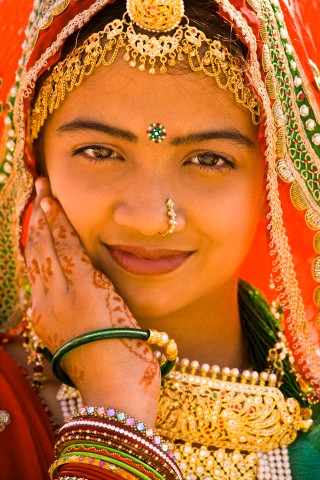
Fashionable Bindi Design
In today’s post I want to write about relevance of color associated with Bindi.
Firstly, Bindi is not associated with women only, but men too used to put a Bindi on their forehead, more popularly known as Tilak. Hindu men put Tilak on their foreheads on auspicious occasions or while praying to God.
Men with a Bindi/Tilak
In ancient times, Bindi of varying colors were used for categorizing men with regard to their place and role in Varna/caste system. Point to note here is that, this Varna System has nothing to do with the caste politics that is preached or executed today. Infact it was based on the roles of a person in the society and not merely on birth.
So Brahmins, who at that time were considered as teachers and priests, used to wear a White Sandalwood Tilak on their forehead. White being the color of purity and of divinity, suited this categorization.
Abhishek Singh in Red Tilak
Kshatriya or Raajputs, used to wear a Red Tilak on their forehead, as they belong to the class of Kings, warriors, ministers and administrators. Red being the color of passion, courage and of heroism, deserve nothing less than belonging to Kshatriya Varna.
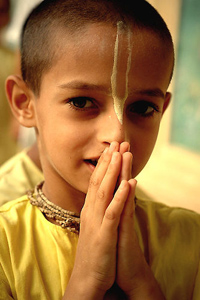
A Boy in Yellow Tilak
A Yellow Tilak was used by the Vaishya Varna of the society, as they were the businessmen, traders and man of the markets, in the society. Yellow being the color of practicality and prosperity was chosen for Vaishya Varna.
Man with Black Tilak
Shudra Varna of society, which was the service class of society, adorned Black Tilak on their forehead. This tilak has more to do with availability and inexpensiveness of color black, as ashes to peasant class, with respect to expensive sandalwood and kumkum. Black color was used to denote service class.
These four Varna used four different colors of Bindis/Tilak, in earlier times. When it comes to women, they usually wore a Red Kumkum Bindi, if they are married. An unmarried girl usually wore no Bindi, but if she does, she used a black one. A widow or a women who never wished to get married, used the sandalwood white bindi.
Woman Praying
This distinction also has its reasons. Red is color of Love, and a married woman while wearing a Red Bindi, represents and proclaims her love towards her husband. When she is unmarried, she is thought to be as in, not in love with anyone, and ash which was used as black color Bindi earlier, denotes no worldly love. A sandalwood white Bindi was adorned by widowed and priestesses, to show their love towards divinity, the God. Interchangeably they have used Black Bindi too.
Red Bindi over Black Ashes
In south of India, a different combination of color is used to worn a Bindi on Forehead, wherein a black horizontal line is drawn along with a Red Bindi, on a forehead.
Black again is the color taken from ashes, which represents Shiva. Shiva himself is depicted covered in ashes all the time, as he is beyond the worldly desires. While Red Bindi, here signifies Shakti, the ultimate energy. This kind of Bindi denotes the super fusion of both Shiva and Shakti into Aadidev Ardhnaarishwar.
Now that I have written almost everything about the grandness of color in a Bindi, I must tell you that all that I have written was practiced before. At present, Bindi is more of an accessory. We chose color of Bindi to match as per our outfit and nothing more. Unmarried girls happily adorn a Red Bindi, and so does Married women don’t flutter their eyes while wearing a black or white Bindi.
Only difference being, no more kumkum, sandalwood or ashes are used to make a Bindi, rather a glue or some cheap material is used today to make a modern Bindi. But who is complaining? Not me. 🙂
Helen Keller is an inspiration, not only for those who are deaf and blind but to all of us who have eyes and ears, but still can not see or feel the beauty around us.
“The Story Of My Life”, is the autobiography of Helen Keller, depicting her struggles and their overcoming. This book is about her early life, mostly of first 22 years of her life.
Helen Keller – The Story Of My Life
Helen Keller, was 19 months old, when due to a severe illness, she lost her eyes and hearing abilities. Later, she also becomes mute. Her autobiography “The Story Of My Life”, shows her daily conflicts in very descriptive manners, specially the way she explored everything around her. Mainly her difficulties in making herself understood to others, like her parents and housemaids. Surprisingly even after all of these difficulties of her life, she became to be a great writer and inspiration to the whole world.
Helen with teacher Anne Sullivan
If any person can have the credits to making Helen Keller, the way she is known to everyone today, this credit should go to her Teacher and mentor, Miss Anne Sullivan. In her autobiography Helen has written about how her world was dull and without any hope, till she met her teacher, Anne Sullivan, who brought light and love to Helen’s world. She made her independent enough to live with dignity and not a self pitying physically challenged person.
What makes it happen?
It’s language, learning and books; and lots of patience from her teacher. Anne Sullivan was herself suffering from an eye infection which later took her eye sight completely. She tried to teach Helen by writing letters on her hand, for each word. Specifically the first word that Helen learnt – Water, was the life changing event for her. The way it was written in the book, it makes the whole scene come alive. It was the most beautiful experience what Helen went through when she learned that everything in this world has a name, a word assigned to it.
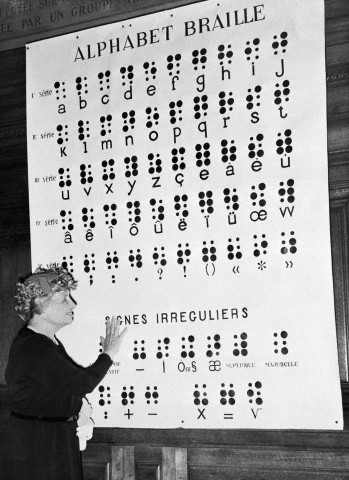
Helen Reading Braile
Helen also wrote about her relationship with her teacher, Anne Sullivan, and her friendship with Oliver Wendell Holmes. This book also had few of the letters shared with her. She also wrote about her first devastating experience of finding out that the first story that she has written is actually already written by someone else, much before her. She clarifies her stand by saying that everything that she has learnt is actually being told by someone or, she has read from others books. So she may have read the story in her childhood but she now has no memory of it.


















 My Journey So Far....